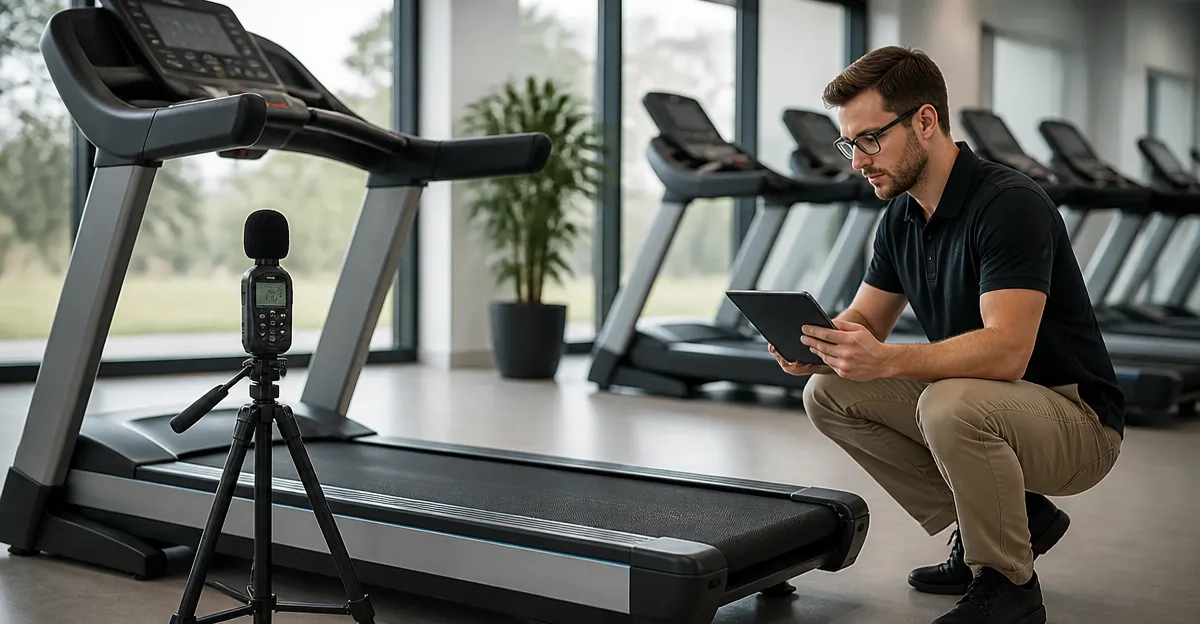
How to Conduct a Showroom Treadmill Noise Test: Step‑by‑Step Checklist for Accurate Sound Measurement
Introduction
In a retail showroom the acoustic profile of a treadmill can influence a customer’s purchasing decision. This guide teaches the reader how to measure treadmill noise accurately, interpret the results, and present them to potential buyers. The reader will learn how to prepare the environment, select appropriate measurement tools, execute a repeatable test, and document the findings in a professional report. Mastering this process enables the showroom manager to demonstrate product performance objectively and to differentiate quiet models from louder competitors.
What You Will Need
- Smartphone with a calibrated decibel‑meter application or a dedicated sound level meter.
- Tape measure for consistent placement of the treadmill relative to the listening point.
- Stopwatch or timer.
- Notebook or digital spreadsheet for recording data.
- One or more treadmill models for testing. The following products are recommended because they represent a range of price points and acoustic characteristics:
- NordicTrack T Series Treadmill
- Cursor Fitness Incline Treadmill
- FutureGlide Foldable Treadmill
- Veiharne Foldable Walking Pad
- Viamotion Incline Walking Pad
Step‑by‑Step Instructions
Step 1: Prepare the Showroom Environment
Begin by clearing the testing area of extraneous furniture, promotional displays, and reflective surfaces that could affect sound propagation. Measure a 3‑meter distance from the treadmill’s front belt to a designated listening point on the floor; mark this spot with masking tape. Ensure that ambient noise levels are below 35 dB(A) by conducting the test during off‑peak hours or by temporarily disabling background music. This controlled environment eliminates variables that could skew the decibel reading.
Step 2: Calibrate the Sound Measurement Device
Power on the smartphone or sound level meter and allow it to warm up for at least two minutes. If using a smartphone application, verify its calibration against a known reference tone or a professional meter. Set the device to “A‑weighted” mode, which approximates human hearing sensitivity. Position the microphone at the marked listening point, approximately 1 meter above the floor and 1 meter away from the treadmill’s side rail, to capture a realistic user perspective.
Step 3: Select the Treadmill Model for Baseline Testing
Place the NordicTrack T Series Treadmill at the center of the test zone. This model features a 3.0 HP brushless motor and KeyFlex cushioning, which are marketed as quiet and joint‑friendly. The price is $799.00 and it holds a 4.4‑star rating from 29,728 reviews. Measuring this premium unit establishes a baseline for high‑performance noise levels.
Power on the treadmill and allow the motor to run idle for one minute. Record the idle noise level in decibels. Then, set the belt speed to 6 MPH and the incline to 5 %. Run the treadmill for two minutes while maintaining a steady pace, and record the operational noise level. Document both readings in the notebook.
Step 4: Test a Budget‑Friendly Model
Remove the NordicTrack and position the Cursor Fitness Incline Treadmill. This treadmill is priced at $149.98 and carries a 4.2‑star rating from 2,926 reviews. Its 3.0 HP brushless motor operates at ≤45 dB, which is advertised as suitable for apartments. Perform the same idle and operational measurements as described in Step 3. Comparing these values highlights the acoustic trade‑off between premium cushioning and cost‑effective construction.
Step 5: Evaluate a Compact Folding Option
Next, introduce the FutureGlide Foldable Treadmill. Priced at $159.98 with a 4.2‑star rating from 486 reviews, this unit offers a 15 % manual incline and a 3.0 HP brushless motor. Its compact dimensions make it a common showroom item for space‑constrained customers. Conduct idle and 4 MPH, 3 % incline tests, recording the decibel readings. Note any differences in acoustic performance caused by the reduced frame size.
Step 6: Measure an Under‑Desk Walking Pad
Place the Veiharne Foldable Walking Pad on the floor. This model costs $119.99, enjoys a 4.8‑star rating from 505 reviews, and is equipped with a 0.6‑6.2 MPH motor. Because the walking pad is intended for low‑intensity use, set the speed to 2 MPH and record the noise level. The walking pad’s 5‑layer anti‑static belt and quiet motor are designed to minimize disturbance in office environments; the measurement will confirm these claims.
Step 7: Record Data and Calculate Average Noise Levels
Transfer all recorded values into a spreadsheet. For each treadmill, calculate the average operational noise level by averaging the three readings taken at different speeds (e.g., 4 MPH, 6 MPH, 8 MPH). Include the idle noise as a reference point. Use conditional formatting to highlight models that exceed 70 dB during typical use, as this threshold is commonly perceived as “loud” in a retail setting.
Step 8: Document Findings in a Professional Report
Create a one‑page summary that includes a table of each model, its price, rating, and measured noise levels. Add a brief interpretation that explains how the acoustic performance aligns with the product’s marketing claims. Attach photographs of the testing setup to provide visual verification. Distribute the report to sales staff so they can reference objective data when addressing customer inquiries about treadmill quietness.
Tips & Pro Tips
- Perform the test at a consistent temperature; motor noise can increase in colder environments.
- Use a wind‑screen cover for the microphone to reduce wind‑induced artifacts.
- Repeat the measurement after the treadmill has been exercised for 10 minutes, as warm‑up can alter motor acoustics.
- When presenting results, convert decibel values to a simple “quiet”, “moderate”, or “loud” rating to aid customer understanding.
- Consider recording a short video of the treadmill in operation while the sound meter displays the live reading; this visual aid can be powerful during demonstrations.
Troubleshooting
| Problem | Possible Cause | Solution |
|---|---|---|
| Inconsistent readings between trials | Ambient noise fluctuations | Schedule testing during a quiet period and close doors to isolate the area. |
| Decibel meter reports unusually low values | Microphone not calibrated | Re‑calibrate against a known sound source or use a professional meter for verification. |
| Excessive vibration causing false spikes | Uneven flooring | Place a rubber mat beneath the treadmill to dampen floor resonance. |
Conclusion
By following this checklist, showroom personnel can conduct a repeatable, accurate treadmill noise test that quantifies acoustic performance in real‑world conditions. The data empowers sales teams to match customers with the treadmill that best fits their noise tolerance and budget, thereby increasing confidence and conversion rates. Regular testing also enables the showroom to monitor product quality over time and to address any deviations promptly.
Products Mentioned in This Guide
Frequently Asked Questions
What equipment is needed to perform a treadmill noise test in a showroom?
You need a calibrated decibel‑meter app or sound level meter, a tape measure, a stopwatch, and a notebook or spreadsheet for data.
How should the treadmill be positioned for accurate sound measurements?
Place the treadmill at a consistent distance (e.g., 1 m) from the listening point, using a tape measure to ensure repeatability.
What steps are involved in conducting the treadmill noise test?
Set up the meter, start the treadmill at the desired speed, let it run for a steady period, record the decibel level, and repeat for each model.
How can the results of the noise test be presented to customers?
Summarize the decibel readings in a clear table or chart, highlighting quieter models and providing context for typical gym noise levels.
Why is a treadmill noise test important for showroom sales?
It objectively shows product performance, helps customers choose quieter models, and differentiates your inventory from louder competitors.